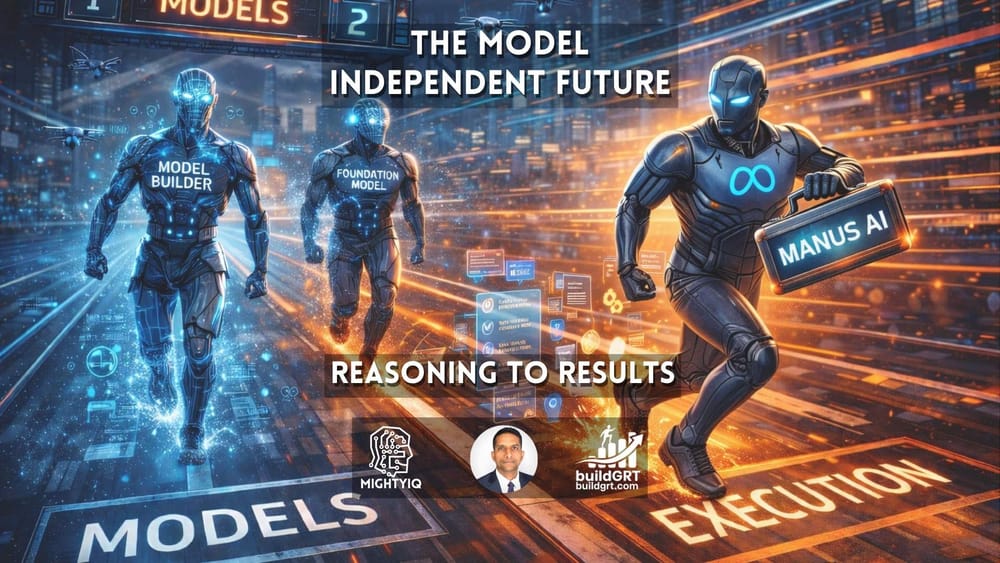
The Model Independent Future - Reasoning To Results
The Model-Independent Future: Agentic Systems That Turn Reasoning into Results
2025 was the year AI stopped being a differentiator and became a shortcut.
If you had AI in your pitch, you got traction.
If you had traction, you got funding.
If you had funding, you got scale.
AI moved from buzzword to productivity engine almost overnight, reshaping entire markets. Businesses rushed in - some with intent, many simply chasing momentum. Valuations followed a new logic, where access began to matter more than ownership.
NVIDIA recently committed to spend over $20B through strategic licensing arrangements to secure compute capacity and proximity to key talent around Groq.
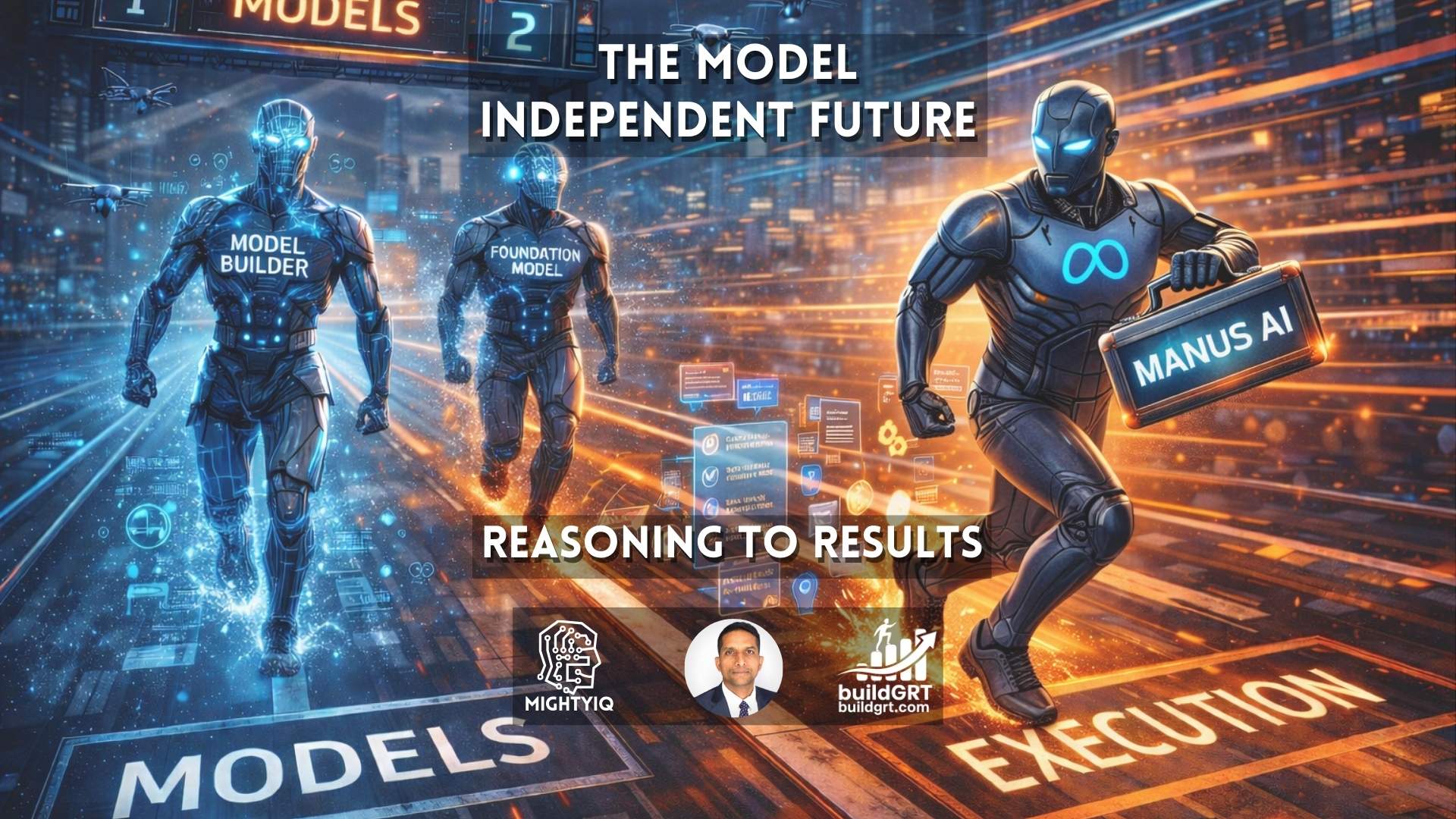
Meta escalated the poach-a-hire arms race with reported compensation packages exceeding $100M, then made a more decisive move by announcing its intent to acquire Manus in a deal valued at roughly $2B.
Manus launched in March 2025 and broke through by focusing on something many overlooked: execution. Rather than improving conversation, it orchestrated models, tools, and workflows into autonomous agents capable of completing real tasks end to end.
The Model-Independent Future reflects a structural shift in AI. As frontier models converge and become increasingly interchangeable, durable value is moving away from intelligence itself and toward systems that can reliably act.
The agentic systems bridge this gap by coupling reasoning with tools, memory, and execution environments turning intent into outcomes rather than conversations. In this future, models power decisions, but results are delivered by orchestration.
The traction was immediate. Enterprises began testing Manus across operational workflows, and waitlists grew rapidly.
Within months, Meta announced its intent to acquire Manus for roughly $2B, turning a viral, Chinese-founded startup - relocated to Singapore—into a prospective core pillar of its enterprise AI strategy.
The speed of the deal was the signal. In a crowded LLM landscape, Manus didn’t chase bigger models. It focused on orchestration, making AI behave less like a chatbot and more like a digital employee.
As 2025 unfolded, the market lesson became unmistakable. AI assistants felt inevitable, but as access to strong models widened, orchestration - not intelligence - emerged as the real bottleneck. Nearly everyone had capable models; very few had systems that could reliably chain them in production.
That context sets up the real question: why Meta moved so fast.
Why Meta Bought Manus AI
Meta moved on Manus for one reason: execution at scale with clear growth leverage.
As language models commoditized, differentiation shifted to orchestration—reliably chaining models, tools, memory, and environments into outcomes.
Manus had already solved this, validated by 86%+ GAIA Level-1 and ~70% Level-2 performance, outperforming chat-first systems on end-to-end execution.
What made the deal compelling were the growth drivers:
- Proven monetization: ~$100M ARR within eight months, without a proprietary model.
- Model independence: Foundation models treated as interchangeable inputs, lowering dependency risk.
- Distribution leverage: Agent workflows fit naturally into WhatsApp, Instagram, and enterprise surfaces.
- Time advantage: Buying compressed years of internal build and integration risk.
- Strategic defense: Secured a production-ready execution layer amid OpenAI and Anthropic pressure.
Bottom line: Meta didn’t buy better models. It bought a validated execution layer with built-in growth.
Key Highlights
1. From Launch to $2B Exit in Under a Year: Manus scaled from launch to a ~$2B acquisition in less than twelve months, driven by strong GAIA benchmark performance and an “acts, not chats” positioning that fueled massive waitlists and enterprise pilots.
2. Orchestration as the Real Differentiator: Rather than chasing larger models, Manus focused on orchestration—chaining multiple LLMs and tools into reliable, end-to-end workflows that delivered execution rather than conversation.
3. Meta’s Speed-and-Leverage Play: Meta’s acquisition was driven by speed, benchmarks, and platform leverage, embedding agent capabilities directly across its ecosystem instead of spending years rebuilding execution layers internally.
4. Global Scale Lessons for Canada and Beyond: The China-to-Singapore pivot highlights a broader truth: global scale depends on proximity to US capital, enterprise buyers, and distribution - while Canada’s opportunity lies in exporting vertical agents for mining, energy, and healthcare.
The Key Takeaway
AI value in 2025 did not compound at the model layer - it compounded at the orchestration layer. As models became commodities, durable advantage shifted to systems that could reliably execute real workflows.
For builders in Halifax or anywhere else, the mandate is clear: don’t chase foundation models. Build systems that do real work, benchmark them relentlessly, and move faster than incumbents can react.
Meta’s acquisition of Manus makes one thing unmistakable - in this cycle, execution beats explanation, and speed beats elegance.
♻️ Repost if this resonates: in AI, as in markets, traction ultimately rewards doers not dreamers.
🌐 Building something new?
If you’re looking for a reliable hosting provider, I’d recommend DreamHost.
We’ve used it for our client websites for over a decade - it’s fast, secure, and built for creators who want peace of mind.
🔔 Stay Connected
If this reflection on navigating an algorithmic world - without losing depth resonated with you, let’s continue the dialogue.
👉 Subscribe to my newsletter, Beyond Growth Playbook, for insights on strategy, technology, and transformation: iamgrt.com
👉 Join the builders shaping what’s next. Real insights, zero noise. buildgrt.com - your ticket to global growth.