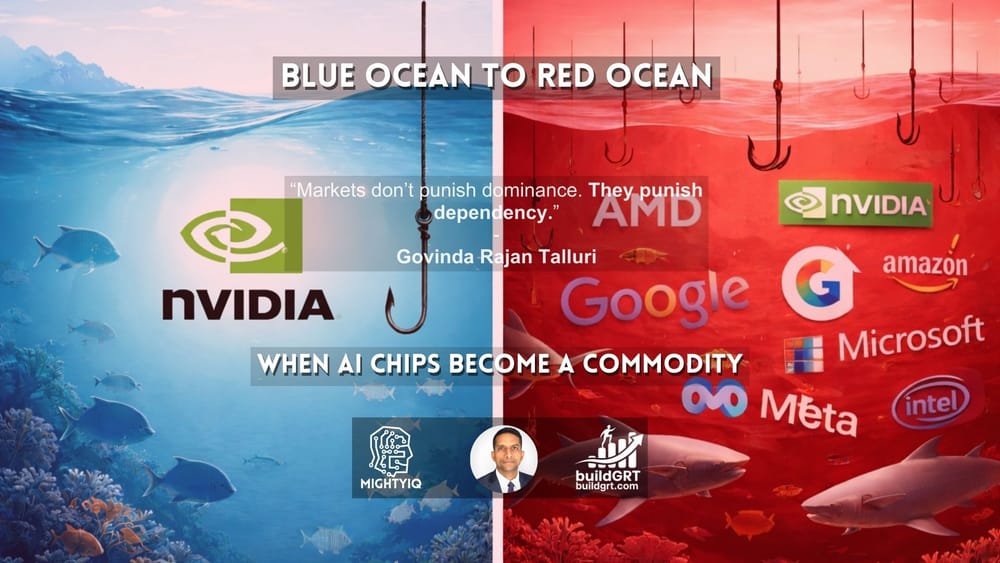
Blue Ocean To Red Ocean
When AI Chips Become a Commodity
Over the past one year, I was documenting my learnings about the AI industry and the boom and the related conversations around AI infrastructure, out of it all - one distinct pattern kept showing up again and again.
Every roadmap.
Every capex discussion.
Every “must-have” slide deck.
NVIDIA.
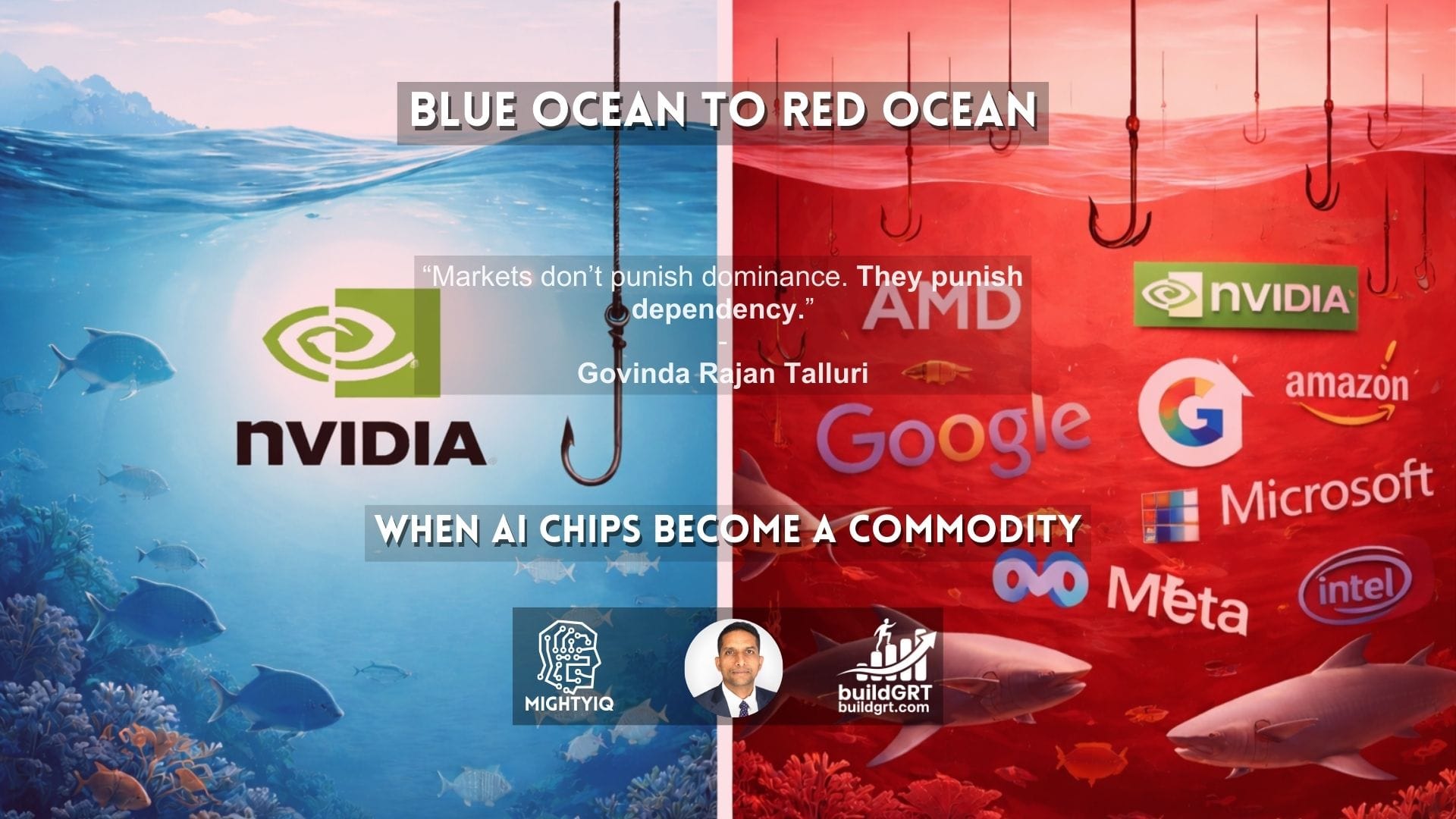
For a while, it felt unquestionable. If you were building serious AI, you built on NVIDIA. Scarcity, CUDA lock-in, and record margins created what looked like an unassailable blue ocean.
But markets don’t stay blue forever.Over the last 12–18 months, something fundamental has shifted. Hyperscalers stopped asking “How do we get more GPUs?” and started asking “Why are we paying this much for compute?”
That question changes everything.
What we’re witnessing now isn’t Nvidia failing — it’s AI compute maturing. And maturity turns scarcity into competition.
When chips become “good enough,” economics beat elegance.
The real race is no longer about the fastest GPU.
It’s about who controls the full-stack economics — silicon, software, energy, utilization, and cost.And that’s where the red ocean begins.
Key Highlights
🌊 Blue oceans are powered by scarcity - red oceans are driven by efficiency
🧠 CUDA created lock-in, but cost pressure creates exits
🏗️ Hyperscalers build custom silicon to protect margins, not to win benchmarks
⚖️ “Best performance” loses to “best economics” at scale
🔁 Commoditization doesn’t kill leaders - it limits their pricing power
NVIDIA will remain a giant.
But giants in red oceans negotiate — they don’t dictate. The deeper lesson here isn’t about chips.
It’s about strategy.
When your customers reach scale, they stop buying products - they start redesigning the system.
“Markets don’t punish dominance. They punish dependency.” - Govind Rajan Talluri
For founders, operators, and builders, this is the real takeaway:
If your moat depends on scarcity, proprietary access, or a single platform’s advantage - it will weaken as your customers scale.
The strongest moats today aren’t built on being the best - they’re built on being structurally cheaper, harder to replace, and aligned with your customer’s long-term economics.
In other words:
- Design for cost curves, not just feature curves
- Assume your biggest customers will eventually build around you
- Build products that survive even when you’re no longer the default choice
What do you think?
Is AI entering its infrastructure phase faster than most companies expected - or are we underestimating how quickly hyperscalers reshape entire markets when margins are at stake?
♻️ Repost if you believe long-term advantage isn’t created by hype or peak performance - but by economics, control, and systems that scale under pressure.
🌐 Building something new?
If you’re looking for a reliable hosting provider, I’d recommend DreamHost.
We’ve used it for our client websites for over a decade - it’s fast, secure, and built for creators who want peace of mind.
🔔 Stay Connected
If this perspective on building meaningful products - beyond hype and into fundamentals - resonated with you, let’s keep the conversation going.
👉 Subscribe to my newsletter, Beyond Growth Playbook, for insights on strategy, technology, and transformation: iamgrt.com
👉 Join the builders shaping what’s next. Real insights, zero noise. buildgrt.com - your ticket to global growth.